
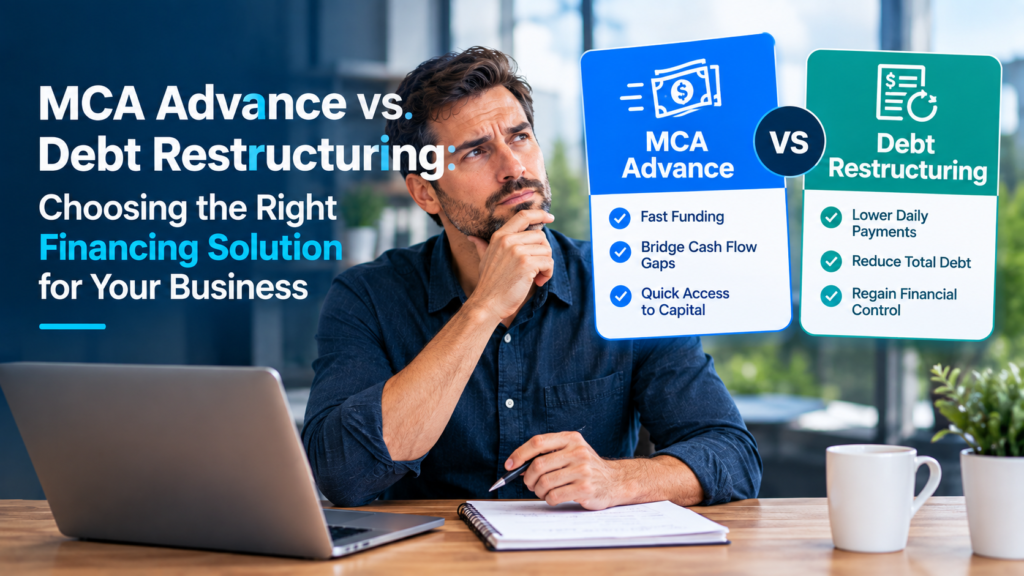
Absolutely — here is the third article, matching the structure, tone, and level of detail of the first two blogs.
MCA Debt Restructuring: A Guide for Business Owners
Merchant cash advances can provide businesses with fast access to working capital, but the repayment structure can become difficult to manage when business conditions change.
A business may experience lower revenue, unexpected expenses, seasonal fluctuations, or simply find itself managing several financing obligations at the same time.
When MCA payments begin putting pressure on daily cash flow, MCA debt restructuring may be one option to explore.
This guide explains what MCA debt restructuring means, why businesses consider it, what the process may involve, and what business owners should understand before moving forward.
What Is MCA Debt Restructuring?
MCA debt restructuring generally involves reviewing existing merchant cash advance obligations and exploring whether the repayment arrangements can be modified or reorganized.
The goal may be to create a repayment structure that is more manageable for the business’s current cash-flow situation.
Depending on the circumstances, discussions may involve:
- Existing MCA providers
- Multiple financing obligations
- Outstanding balances
- Payment schedules
- Business revenue
- Current operating expenses
The available options depend on the specific contracts and financial circumstances of each business.
Why Do Businesses Consider MCA Restructuring?
A business may consider restructuring when its existing repayment obligations become difficult to maintain.
Common reasons include:
Reduced Revenue
A decline in sales can make previously manageable payments more difficult to sustain.
Multiple MCA Obligations
Businesses with several advances may have multiple daily or weekly payment commitments.
Unexpected Expenses
Equipment repairs, supplier costs, payroll increases, or other unexpected expenses can reduce available working capital.
Seasonal Cash Flow
Some businesses experience significant changes in revenue throughout the year, making fixed or frequent payments more challenging during slower periods.
Cash-Flow Pressure
Even when a business remains profitable, frequent withdrawals can leave insufficient cash for normal operations.
How Does MCA Debt Restructuring Work?
The process usually begins with understanding the business’s complete financial position.
Rather than looking at one MCA agreement in isolation, the review should consider the business’s overall obligations and cash flow.
Step 1: Review Existing Obligations
Start by gathering information about every outstanding MCA or business financing agreement.
This may include:
- Original funding amounts
- Outstanding balances
- Payment amounts
- Payment frequency
- Remaining repayment obligations
- Contract terms
Having this information organized helps establish a clear picture of the current situation.
Step 2: Review Business Cash Flow
The next step is to understand how much money is coming into and leaving the business.
This can include reviewing:
- Business bank statements
- Monthly revenue
- Payroll
- Rent
- Supplier payments
- Utilities
- Taxes
- Other business expenses
- Existing financing payments
The purpose is to understand what the business can realistically manage.
Step 3: Identify the Main Pressure Points
Not every financial obligation has the same impact.
A review may identify which payments are consuming the largest portion of available cash flow and whether multiple obligations are contributing to the problem.
Step 4: Explore Potential Options
Once the financial situation is understood, the business can explore potential approaches.
Depending on the circumstances and contractual terms, this could involve discussions about alternative payment arrangements or other restructuring strategies.
There is no universal restructuring solution. What may be appropriate for one business may not be suitable for another.
Step 5: Review Any Proposed Agreement Carefully
Before accepting a restructuring arrangement, business owners should carefully review the proposed terms.
Pay attention to:
- Total repayment obligation
- Payment amount
- Payment frequency
- Duration of the arrangement
- Fees
- Contractual requirements
- Default provisions
- Any other important terms
If necessary, businesses should seek appropriate legal or financial advice before signing.
MCA Restructuring vs. Taking Another Advance
When a business is struggling with an existing MCA, taking another advance may appear to provide an immediate solution.
However, additional financing can also create another repayment obligation.
For this reason, businesses should compare the impact of new financing with the potential benefits of reviewing their existing obligations.
Consider the complete picture:
Current payments + operating expenses + new repayment obligation = total cash-flow commitment
If the business cannot comfortably manage the combined obligation, additional funding may increase financial pressure rather than resolve it.
What Is MCA Stacking?
MCA stacking occurs when a business takes multiple merchant cash advances while previous advances are still outstanding.
Stacking can make restructuring more complicated because the business may be dealing with several financing companies and repayment schedules simultaneously.
A restructuring review should therefore consider all existing obligations together.
Understanding the total amount being withdrawn from the business each day or week can help show the actual level of repayment pressure.
Signs Your Business May Need a Financial Review
Not every business with an MCA needs restructuring. However, certain warning signs may indicate that it is time to review the situation.
These can include:
- Regularly having insufficient funds for operating expenses
- Difficulty meeting payroll or supplier payments
- Multiple daily ACH withdrawals
- Taking new advances to cover existing obligations
- Consistently declining bank balances
- Increasing reliance on credit
- Falling behind on important business expenses
- Significant changes in monthly revenue
These signs do not automatically mean restructuring is necessary, but they can indicate that the business should take a closer look at its financial commitments.
What Documents Are Usually Helpful?
A complete financial review is easier when the relevant documents are available.
Business owners may want to prepare:
Bank Statements
Recent business bank statements can help show revenue, expenses, and financing withdrawals.
MCA Agreements
Copies of existing agreements can help identify payment terms and outstanding obligations.
Payment Information
Details about current daily or weekly withdrawals can help establish the total repayment burden.
Revenue Records
Recent sales and revenue information can provide context about the business’s current cash flow.
Expense Information
Operating expenses such as payroll, rent, inventory, and supplier payments should also be considered.
Can Every MCA Be Restructured?
Not necessarily.
The possibility of restructuring depends on factors such as the specific agreement, provider, outstanding balance, payment history, business revenue, and overall circumstances.
Some situations may require negotiation, while others may involve different financial or legal considerations.
Business owners should avoid assuming that a particular restructuring outcome is guaranteed.
Why Understanding the Numbers Matters
MCA restructuring is ultimately about understanding the relationship between business revenue, operating expenses, and financing obligations.
For example, if a business generates $80,000 per month but has $20,000 in financing payments and $55,000 in essential operating expenses, only $5,000 may remain before other costs.
Looking only at the $80,000 revenue figure would not provide an accurate picture of the company’s available cash flow.
This is why a complete financial review is important before considering any new arrangement.
Questions to Ask Before Restructuring
Before entering into a restructuring arrangement, consider asking:
- What is my current total outstanding balance?
- How much am I paying each day or week?
- What will the new payment amount be?
- How long will the new arrangement last?
- What is the total amount I will repay?
- Are there additional fees?
- What happens if business revenue changes?
- Are all existing obligations included?
- What contractual requirements will apply?
- Have I reviewed the agreement carefully?
Getting clear answers to these questions can help you understand the proposed arrangement before committing to it.
Benefits and Considerations of Restructuring
Restructuring may potentially help a business manage repayment obligations in a way that better reflects its current circumstances.
However, restructuring does not eliminate the underlying financial obligation.
Business owners should consider both sides.
Potential Considerations
- A different repayment structure may improve cash-flow management.
- Multiple obligations may potentially be addressed as part of a broader review.
- A clearer repayment plan may make financial planning easier.
Important Things to Review
- Total repayment amount
- Length of the repayment period
- Any additional costs
- Contract terms
- Business affordability
- Long-term impact on cash flow
The actual outcome depends on the business and the terms that can be negotiated.
The Importance of Acting Before Cash Flow Becomes Critical
When financing payments begin creating problems, delaying a review can make the situation more difficult.
Businesses should consider reviewing their finances as soon as they recognize that current obligations may no longer be sustainable.
Early assessment can help business owners understand their position and evaluate potential options before the situation becomes more complicated.
Final Thoughts
MCA debt restructuring can be an important consideration for businesses dealing with difficult repayment schedules, multiple advances, or changing cash-flow conditions.
The first step is not necessarily taking more financing. It is understanding what the business currently owes, how much it is paying, and what it can realistically afford.
A careful review of existing MCA agreements, business revenue, operating expenses, and repayment obligations can help provide a clearer picture of the available options.
If your business is struggling with MCA payments, consider reviewing your financial situation and obtaining appropriate professional advice before making another financing decision.
Need Help Reviewing Your MCA Obligations?
Managing multiple financing obligations can be challenging, especially when daily payments begin affecting normal business operations.
Our team can review your current MCA situation, discuss your circumstances, and help you understand potential MCA debt restructuring and business funding options.
Contact us today to discuss your situation.